
AI SEO: How Modern SEO & AI Search Systems Work with RAG, Entity Optimization, Passage Retrieval & Synthetic Queries
AI SEO is changing how websites appear in Google AI Overviews, ChatGPT, and Perplexity, where users now get direct answers without even opening websites.
That happens because modern search systems no longer read pages the same way older search engines did. They now try to understand meaning, entities, headings, semantic relationships, and even individual paragraphs before deciding what content deserves visibility.
If you are writing blogs, service pages, or SEO content, understanding how AI retrieval works is becoming just as important as traditional SEO.
Table of Contents
Document-Level Retrieval vs Passage-Level Retrieval
Earlier search engines mostly ranked entire pages. If a page matched a keyword well, the whole document could rank.
As search engines improved, they started focusing more on the exact answer and meaning instead of ranking only the full page.
Now AI systems often retrieve only a small section from a page. This is called passage-level retrieval.
For example, imagine a blog about digital marketing courses. The article may discuss:
- SEO training
- Google Ads
- internships
- live projects
- certifications
If someone searches:
“Does a digital marketing course include live project training?”
Google may only extract the paragraph discussing live projects instead of ranking the entire page.
That is why content structure matters more now.
Small, focused sections with clear headings perform better because AI systems can understand them faster.
You can also read more about semantic content structure for SEO and how Google AI Overviews work to understand why clean formatting matters
Atomic Sentences & Discourse Boundary Penalty
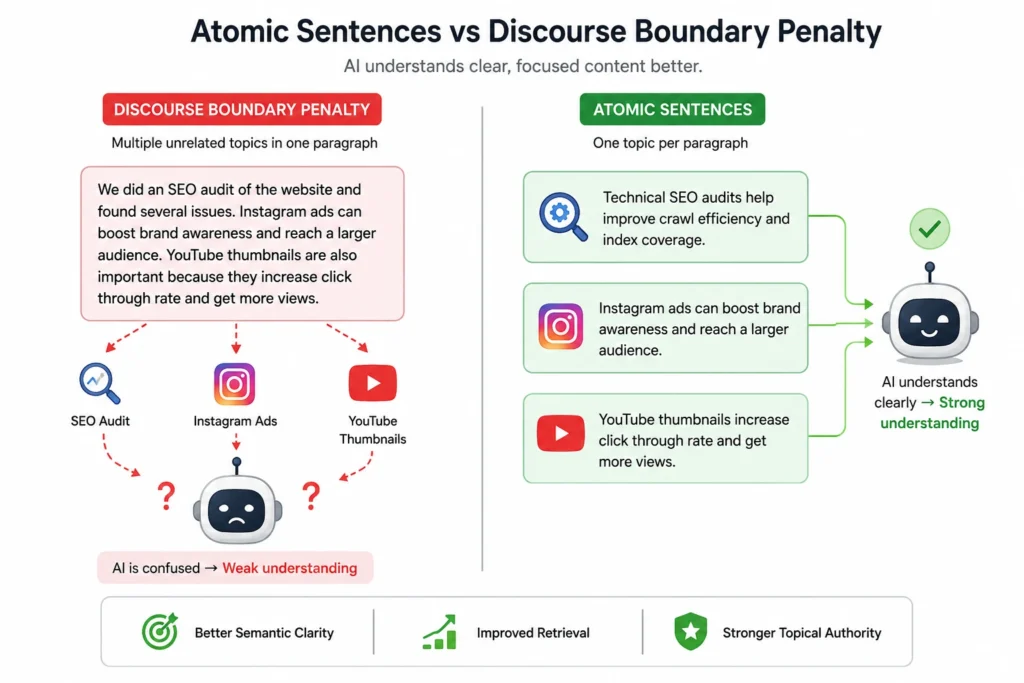
Modern AI SEO retrieval systems prefer sentences that make complete sense on their own.
These are called atomic sentences.
Instead of writing:
“This helps improve rankings.”
Write:
“Technical SEO audits help improve crawl efficiency and index coverage.”
The second version contains:
- context
- action
- entity
- meaning
AI systems process those sentences more accurately.
Another issue is something called discourse boundary penalty.
This happens when too many unrelated topics are mixed inside the same paragraph.
For example, if a paragraph suddenly jumps from SEO audits to Instagram ads and then to YouTube thumbnails, semantic clarity becomes weaker.
Good AI-friendly writing usually follows one rule:
One topic per paragraph.
That is also why topical authority SEO and content clustering strategies are becoming more important in modern SEO.
RAG (Retrieval-Augmented Generation)
Retrieval-Augmented Generation is one of the biggest shifts happening in AI search.
RAG combines:
- retrieval systems
- vector search
- large language models
Instead of generating answers only from training data, the AI first retrieves relevant information from external sources and then generates a response.
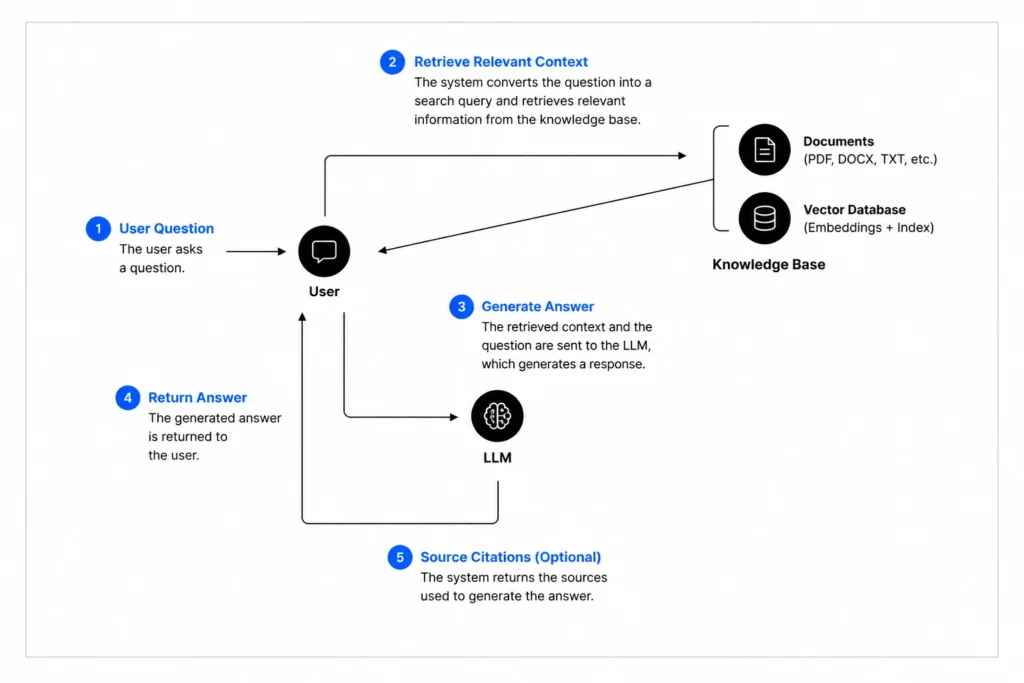
The process usually works like this:
Step | Process |
1 | User asks a question |
2 | Retrieval system searches relevant passages |
3 | AI reads retrieved content |
4 | Final answer gets generated |
This improves factual accuracy and freshness.
Many AI search tools now rely on RAG systems.
Verified Sources
You can also read more about how RAG changes SEO content strategy and vector search systems in AI.
Thematic Clustering
Search engines now try to understand whether a website consistently covers related topics instead of publishing random articles without connection.
This is called thematic clustering.
For example, a digital marketing institute website may contain separate pages about:
- technical SEO
- on-page SEO
- EEAT
- Google Ads
- social media marketing
- content strategy
When these pages connect naturally through internal links and semantic relationships, search systems understand that the website has stronger topical depth.
Websites covering topics like SEO, Google Ads, and content strategy usually build stronger topical relevance across digital marketing searches.
Properly connected topic clusters and semantic relationships in your content also improve AI SEO visibility for semantically related searches.
A website with properly connected topic clusters usually performs better than a website publishing unrelated content pieces.
For example, if a website frequently publishes content about:
- AI SEO
- semantic search
- RAG
- entity optimization
- vector embeddings
search engines start associating that domain with modern AI search topics.
This is why many SEO professionals now focus on topical authority SEO, semantic content architecture, and topic cluster strategies instead of isolated keyword targeting.
IDF Scoring
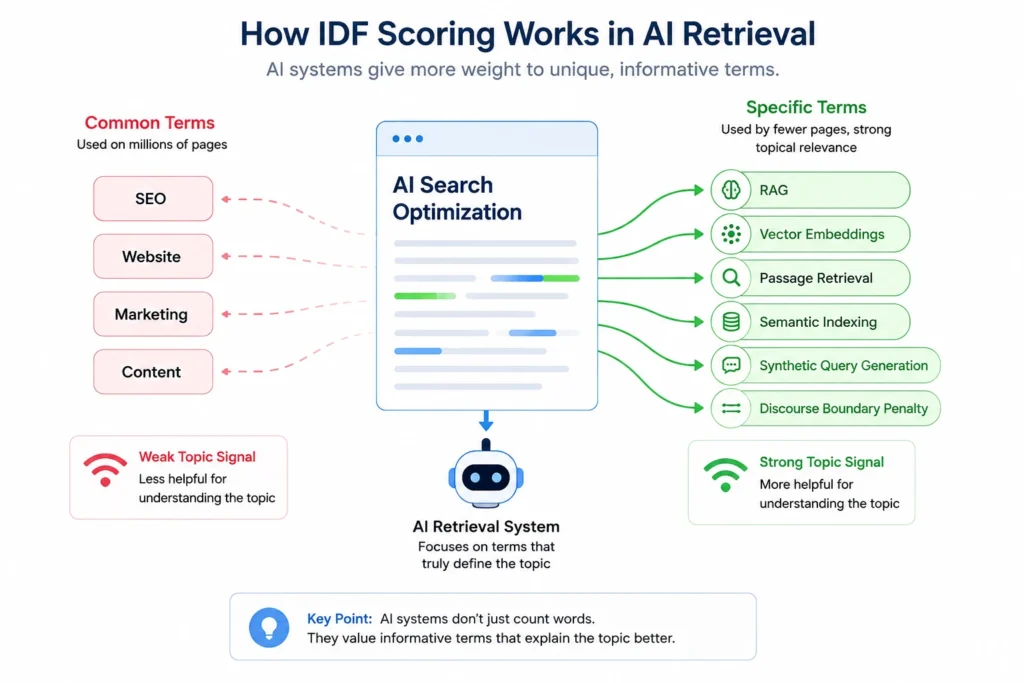
IDF stands for Inverse Document Frequency.
It is a scoring method used in information retrieval systems to measure how informative or unique a term is across documents.
Words that appear everywhere carry lower informational value.
For example:
- SEO
- website
- marketing
- content
appear on millions of pages.
But terms like:
- passage retrieval
- vector embeddings
- synthetic query generation
- discourse boundary penalty
carry stronger topical relevance because fewer websites use them accurately and contextually.
AI retrieval systems use IDF scoring to identify which terms help define the actual topic of a document.
For example, an article mentioning:
- RAG
- retrieval systems
- embeddings
- semantic indexing
gives stronger topical signals for AI search optimization than an article repeatedly using only the keyword “SEO.”
This is why AI SEO strategies now prioritize topical relevance over repetitive keyword usage.
Entity-Based Optimization
Modern AI systems rely heavily on entities instead of just keywords.
An entity is a clearly identifiable thing such as:
- OpenAI
- Google Search Console
- Search Engine Optimization
When content naturally connects these entities together, AI systems understand context much better.
For example, an article about RAG may also mention:
- embeddings
- vector databases
- retrieval pipelines
- LLMs
- semantic search
These connected entities help search systems identify the actual subject of the content.
This is why many modern SEO professionals now focus on entity mapping in SEO instead of writing pages only around keywords.
Heading Vector Systems
Headings now play a much bigger role in AI search visibility.
AI systems convert headings and paragraphs into vector embeddings to understand semantic similarity and topic relevance.
A weak heading like:
“Benefits of SEO”
does not provide much context.
But a heading like:
“How Passage-Level Retrieval Changes SEO Content Structure”
gives stronger topical signals because it clearly explains the subject.
This helps AI systems understand:
- what the section is about
- which queries it may answer
- how relevant it is to a search intent
That is why modern SEO content now uses more descriptive and semantically clear headings instead of short generic titles.
This is also connected to AI retrieval optimization and semantic content structure.
PMI in Query Matching
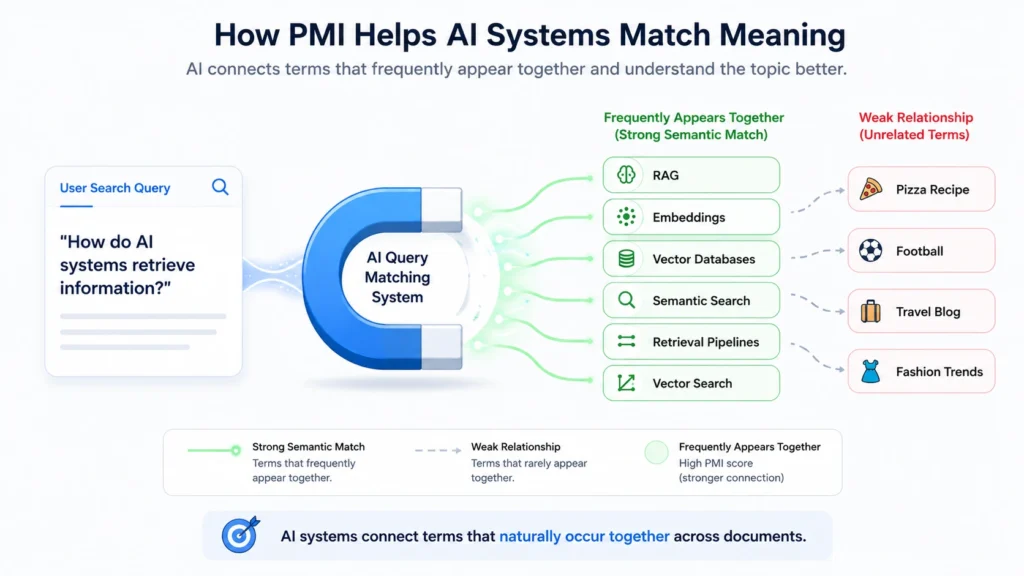
PMI stands for Pointwise Mutual Information.
It measures how often related terms appear together across documents.
AI systems use these relationships to understand whether a page genuinely covers a topic or simply mentions keywords randomly.
For example, the term “RAG” often appears together with:
- vector databases
- embeddings
- retrieval systems
- semantic search
Because these terms frequently appear together, AI systems understand they are strongly related.
PMI relationships now play a major role in AI SEO query matching.
For example, if someone searches:
“How do AI systems retrieve information?”
Pages containing connected terms like:
- RAG
- embeddings
- vector search
- retrieval pipelines
usually perform better because the semantic relationship is stronger.
This is an important part of query-answer matching systems and modern AI search optimization.
Synthetic Query Generation
One interesting change in modern AI search is synthetic query generation.
This means AI systems can automatically generate possible user questions from your content.
For example, a page about technical SEO audits may generate hidden query patterns like:
- What is a technical SEO audit?
- Why are pages not indexed?
- How does crawl budget work?
- What tools are used for SEO auditing?
This helps search systems understand what problems your content can solve.
Pages written with:
- direct answers
- clean headings
- FAQ sections
- semantic consistency
usually perform better here.
That is why many SEO professionals now build content around search intent mapping and AI-friendly FAQ optimization.
GINGER & Synthetic Query Expansion
GINGER is linked with retrieval refinement and semantic query expansion techniques used in modern AI search systems.
The goal is simple:
Help AI systems connect user intent with the most relevant passage possible.
Modern AI SEO systems now focus more on semantic relationships and retrieval accuracy.
For example, a page targeting:
“SEO course in Kerala”
may also become relevant for searches like:
- digital marketing training in Kochi
- SEO internship course
- AI SEO classes
- live SEO project training
This happens because AI systems understand semantic relationships between queries, topics, entities, and passages.
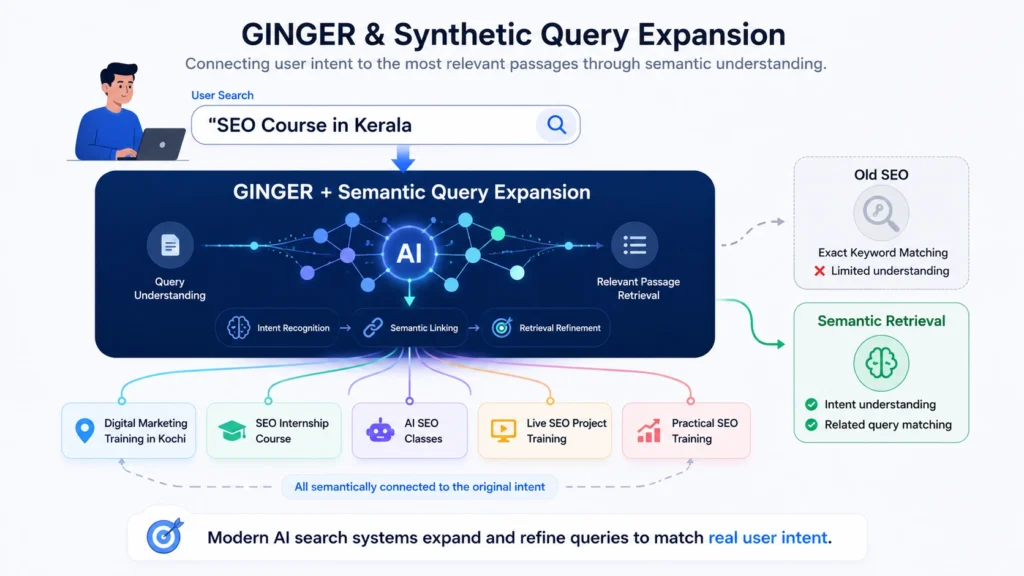
Synthetic query expansion helps systems generate related query variations, while retrieval frameworks like GINGER help improve matching and ranking quality.
This is one reason semantic search optimization matters more today than old-school keyword stuffing.
Common Mistakes That Hurt AI Retrieval Visibility
Many websites still write content for older ranking systems.
That approach often fails in AI search.
Some common issues include:
- long paragraphs without structure
- generic headings
- weak entity usage
- repeated filler lines
- topic mixing
- excessive keyword repetition
- poor FAQ formatting
Modern AI retrieval systems prefer content that is:
- clear
- structured
- semantically connected
- easy to extract
- easy to summarize
Wrapping Up
AI SEO is moving beyond traditional keyword optimization alone.
Modern AI search systems now evaluate:
- semantic clarity
- topical relationships
- entity connections
- retrieval quality
- query matching
- content structure
Understanding concepts like passage retrieval, RAG, entity optimization, thematic clustering, and synthetic query generation helps writers create content that performs better in AI-powered search systems.
If you are learning SEO today, understanding how AI retrieval works is becoming part of modern search optimization itself. Students looking to learn practical AI SEO concepts can also check the digital marketing training programs available at Clear My Course.
FAQs
How do AI search engines understand relationships between topics?
AI search engines use semantic analysis, entities, and contextual relationships to connect related topics and understand content meaning.
Why is topical authority important in AI-driven search systems?
Topical authority helps AI systems identify websites with strong subject relevance and trustworthy content coverage.
How do large language models (LLMs) process website content?
LLMs process website content by analyzing language patterns, entities, context, and semantic meaning instead of only keywords.
What is the difference between keyword-based search and semantic search?
Keyword-based search matches exact terms, while semantic search understands intent, context, and topic relationships.
How do AI search systems identify trustworthy content sources?
AI search systems evaluate content quality, relevance, authority, entity signals, and consistency across trusted sources.
Why does content structure matter in AI-powered search visibility?
Clear content structure helps AI systems understand headings, context, answers, and topic hierarchy more accurately.
How do NLP and entity recognition improve search accuracy?
NLP and entity recognition help search engines understand people, brands, locations, and concepts with better contextual accuracy.
What factors influence visibility in AI-generated answers and summaries?
Semantic relevance, topical authority, structured content, entity optimization, and trustworthy information influence AI search visibility.
