
What Is IDF in SEO? How Search Engines Use Inverse Document Frequency to Rank Pages.
Search engines process billions of queries every day. To deliver the most relevant results, they need a way to determine which pages genuinely match a user’s search.
One of the foundational concepts behind this process is Inverse Document Frequency (IDF). IDF helps search engines identify words that are highly specific to a topic and ignore words that appear on almost every page.
Understanding IDF helps explain how search engines evaluate content relevance and determine which pages deserve to rank.
What Is IDF (Inverse Document Frequency)?
Inverse Document Frequency (IDF) is a metric used to determine how uncommon a word is across a large set of documents, often referred to as a corpus.
The rarer a term is, the higher its IDF score. Common words receive very low scores because they appear on most pages.
Search engines use IDF because some words are far more useful than others when identifying a page’s topic.
For example:
Words like “the,” “is,” and “and” appear on millions of pages.
Words like “bioluminescent plankton” appear on very few pages.
As a result, “bioluminescent plankton” carries much more weight when search engines determine what a page is about.
IDF helps search engines distinguish topic-specific words from common words that provide little ranking value.
How Does IDF Work in Search Engines?
Search engines calculate IDF using a mathematical formula that compares:
- The total number of pages or documents available in the search index
- The number of pages that contain the keyword being evaluated
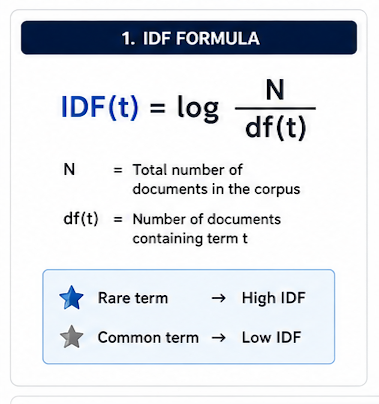
The fewer documents that contain a term, the higher its IDF score.
In simple terms:
- Rare keywords receive higher importance.
- Common keywords receive lower importance.
Words such as “a,” “of,” and “to” have extremely low IDF scores because they appear almost everywhere.
More specific terms such as “ketosis,” “blockchain consensus,” or “myocardial infarction” receive much higher scores because they help identify a page’s topic more accurately.
So, Search engines assign more value to rare, topic-specific terms than to generic words used across the web.
TF vs IDF: What Do They Actually Measure?
Search engines rarely use IDF alone. Instead, they combine it with Term Frequency (TF).
Term Frequency (TF) measures how often a term appears within one specific page. A page mentioning “link building” 15 times in 500 words has a higher TF for that term than a page mentioning it twice in 2,000 words. TF is a page-level metric that does not account for how common the word is elsewhere on the web.
IDF is the opposite – a corpus-level metric. It stays fixed regardless of which page is being scored. The IDF of “bioluminescence” is the same whether you’re evaluating a marine biology article or a general science homepage.
TF vs IDF at a Glance
| TF (Term Frequency) | IDF (Inverse Document Frequency) |
|---|---|
| Measures frequency within a page | Measures rarity across all pages |
| Page-level metric | Corpus-level metric |
| Changes from page to page | Remains fixed across documents |
| Identifies topic emphasis | Identifies keyword importance |
| Can increase with repetition | Cannot be increased by repetition |
Search engines combine these signals using TF-IDF:
A keyword with both high TF and high IDF contributes the most to relevance scoring.
TF tells search engines what a page emphasizes. IDF tells them whether those words are actually important.
Why Do Search Engines Use IDF to Evaluate Content Relevance?
Search engines use IDF because not all words contribute equally to relevance.
Identifying Topic-Specific Terms
Rare terms help search engines understand what a page is about.
For example, a cardiology article containing terms like “troponin” and “stent placement” provides stronger topical signals than repeatedly using the word “heart.”
Reducing Keyword Stuffing
Repeating a keyword increases TF, but it does not increase IDF.
Modern ranking systems also limit the benefit of excessive repetition, making keyword stuffing ineffective.
Improving Search Quality
Without IDF, extremely common words could influence rankings unfairly.
IDF makes sure that topic-defining terms carry more weight than generic words.
Through this, IDF helps search engines prioritize meaningful keywords and reduce the impact of generic language.
Does Google Still Use TF-IDF and IDF Today?
Many SEO professionals wonder whether IDF still matters in the age of AI-powered search.
Google does not publicly confirm TF-IDF as a ranking factor. However, concepts such as term weighting and document frequency continue to influence modern relevance systems.
Today’s search engines combine IDF with additional signals, including:
- BM25 for advanced relevance scoring
- PageRank for authority evaluation
- BERT and MUM for semantic understanding
- Knowledge Graph for entity relationships
- User behavior signals for ranking refinement
IDF remains an important foundation, but it is only one part of a much larger ranking system.
Modern search engines still use relevance signals inspired by IDF, but they combine them with AI, semantic understanding, and user behavior data.
How Do Modern Search Engines Go Beyond IDF?
IDF is useful for measuring keyword relevance, but modern search engines do much more than count and compare words. Modern search engines evaluate meaning and context, not just keyword frequency.
As AI-driven search becomes more advanced, understanding concepts such as retrieval systems, semantic search, and machine learning is increasingly important for SEO professionals. To explore these concepts in greater detail, read our guide on AI SEO and Modern Search Systems.
Entity-Based Search
Search engines identify entities such as people, places, products, organizations, and concepts.
This helps them understand topics beyond individual keywords.
Semantic Relationships
Search engines understand related terms and synonyms.
For example, “hypertension” and “high blood pressure” are recognized as the same concept.
Machine Learning Ranking
Systems like RankBrain analyze user behavior to determine which results best satisfy a search query.
This helps rankings improve over time.
How Can SEO Professionals Use TF-IDF for Content Optimization?
Although TF-IDF is not a direct ranking factor, it remains useful for content analysis.
SEO professionals commonly use TF-IDF to:
- Identify missing topic-related terms
- Find content gaps compared to competitors
- Improve topical coverage
- Prevent keyword overuse
- Strengthen semantic relevance
Popular TF-IDF tools include:
- Clearscope
- Surfer SEO
- MarketMuse
- Frase
- SEMrush Writing Assistant
TF-IDF works best as a content gap analysis tool rather than a content-writing formula.
Can TF-IDF Improve Rankings?
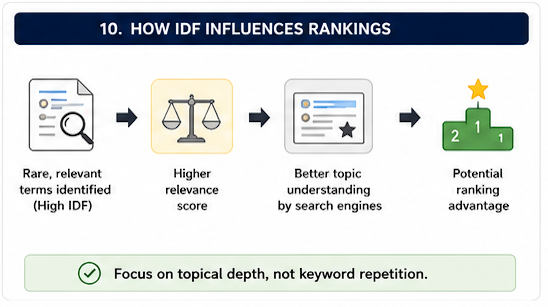
TF-IDF cannot guarantee higher rankings, but it can improve content relevance when used correctly.
When It Helps
- Identifies missing topic-related terms
- Helps pages close content gaps
- Improves topical completeness
- Useful when updating older content
When It Doesn’t Help
- Competitors have significantly stronger authority
- The query is highly transactional or branded
- Technical SEO issues are limiting performance
Examples include:
- Crawlability problems
- Poor Core Web Vitals
- Indexation issues
Best Practices
- Use TF-IDF for gap analysis
- Focus on terms common among top-ranking pages
- Combine findings with search intent research
- Reassess results after 60–90 days
TF-IDF can improve relevance, but it cannot replace authority, technical SEO, or search intent optimization.
Common Misconceptions About IDF in SEO
IDF is often misunderstood in SEO discussions.
TF-IDF Is Not a Direct Ranking Factor
Google does not provide a TF-IDF score that websites can optimize for directly.
It is best viewed as a framework for understanding relevance.
More Keywords Do Not Guarantee Better Rankings
Repeating a keyword does not increase its IDF score.
Modern ranking systems reduce the value of excessive repetition.
Semantic Relevance Matters More Than Density
Search engines increasingly reward comprehensive topic coverage over keyword repetition.
A page that naturally covers related concepts often performs better than one focused solely on keyword density.
So, Modern SEO is about topical relevance and content quality, not keyword repetition.
Conclusion
IDF remains one of the foundational concepts behind search relevance. It helps search engines identify the words that best describe a topic and reduce the influence of generic language.
While modern search engines now use semantic search, machine learning, entities, and user behavior signals, the core principle remains the same: topic-specific language helps search engines understand content.
As AI-powered search continues to evolve, understanding how retrieval systems work is becoming an important part of modern SEO. Those interested in building practical AI and search optimization skills can explore the digital marketing courses offered by Clear My Course.
Frequently Asked Questions
What Is IDF in SEO?
IDF measures how rare a keyword is across a collection of documents. Search engines use it to determine which terms are most useful for identifying a page’s topic.
Does Google Use TF-IDF?
Google does not publicly confirm TF-IDF as a ranking factor. However, document frequency and term weighting concepts still influence modern search systems.
Is TF-IDF Better Than Keyword Density?
Yes. TF-IDF considers both frequency and rarity, making it a more useful relevance metric than keyword density alone.
What Tools Measure TF-IDF?
Popular options include Clearscope, Surfer SEO, MarketMuse, Frase, SEMrush Writing Assistant, and Screaming Frog.
